Periods in crisis: How Sudan’s displaced women are coping as aid shrinks
In a crowded displacement camp in Sudan, a young girl folds a bundle of worn cloth and tucks it beneath her mattress. It is all she has to manage her period. With little or no water available, she cannot wash it properly and must reuse it as best she can, drying it indoors where it remains hidden from view.
For thousands of women and girls across Sudan, this is a routine shaped by almost three years of conflict, displacement, and economic collapse.
Fatma Osheik knows this reality all too well. Before leaving Sudan for the UK in 2019, she experienced firsthand the daily challenges of managing menstruation in conditions of scarcity and insecurity. Today, she channels that experience into her work supporting displaced women and girls as founder of the Pad Needed Dignity Seeded Initiative (PNDS).
As Sudan’s conflict deepens, international aid has dropped sharply: the UN’s 2026 Humanitarian Needs and Response Plan requests nearly one-third less funding than last year, intensifying health risks, stigma, and barriers to education and daily life for women and girls.
Community-led initiatives, like PNDS, are stepping in where international aid has stalled, highlighting both the human cost of funding gaps and the growing desire to reduce reliance on foreign aid.
A crisis within a crisis
Sudan is facing one of the world’s largest displacement emergencies. More than 9.3 million people have been forced from their homes since the conflict escalated in April 2023, according to the UN.
Meanwhile, humanitarian capacity continues to shrink. A survey by the Sudan INGO Forum warns that over 20 million people could lose access to essential services in the coming months, with more than 340 health facilities at risk of closure. Major organisations report severe funding losses, forcing them to scale back or suspend operations altogether.
In such conditions, menstrual health is often deprioritised. Food, shelter, and emergency medical care take precedence, leaving little room for what is still widely viewed as a secondary concern. Yet for those affected, the consequences are far from minor.
“Before the war, menstrual products were available in supermarkets and pharmacies,” Fatma explains. “Now prices are unpredictable, availability is limited, and families must choose between food and pads.”
"Rashes, sores and discomfort"
At El-Geneina Teaching Hospital in West Darfur, one of the few functioning healthcare facilities in the region, midwife supervisor Halima Al Sadeya Adam Ibrahim sees the challenges daily.
“Women and girls are exposed to vaginal infections, urinary tract infections, psychological distress, low self-esteem, and potential infertility,” she says.
With funding cuts, only one NGO is currently distributing dignity kits in Sudan. Even then, access to clean water, sanitation, and private spaces remains limited -making safe menstrual management nearly impossible.
More than 1,000 miles away, in Um Rakuba camp in eastern Sudan, the picture is much the same.
“The shame isolates them from school, work, and social life. Some develop rashes or wounds from improvised materials,” says Barbara King Nuako, a midwife working in the camp.
These experiences highlight how period poverty intersects with wider risks - anaemia, gender-based violence, and disrupted education. In already fragile settings, these impacts deepen existing inequalities.
Local solutions, global gaps
As international aid contracts, local organisations have become increasingly important. PNDS, founded in Khartoum in 2020, is among the few initiatives still operating during the conflict.
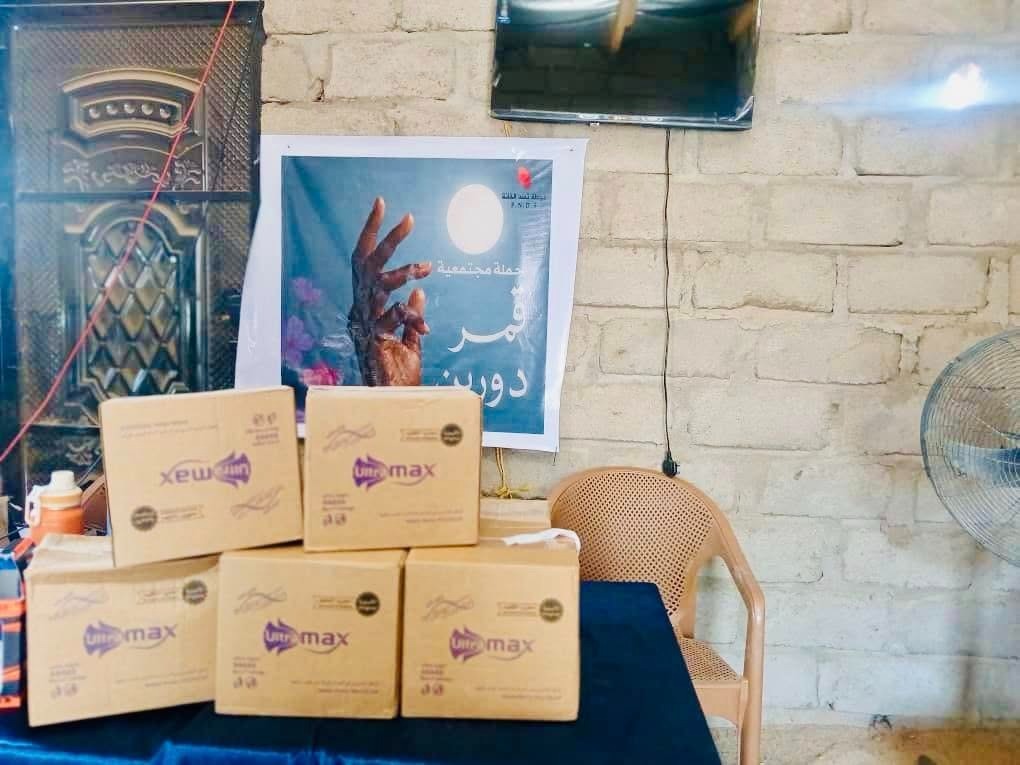
Now based in the UK, Fatma works with networks on the ground to distribute menstrual supplies and run awareness campaigns. The organisation relies heavily on community fundraising and local partnerships rather than large-scale international backing.
“We have very limited ties to international NGOs due to power dynamics,” she says. “The humanitarian sector is unpredictable and dependent on Trump’s agenda. We need to break the cycle of dependency and empower communities.”
But, even for local actors with strong networks, delivering the necessary supplies is not easy.
In Khartoum, pads sourced through trusted suppliers cost around £0.07 each. In remote regions like West Kordofan, that price can rise to £0.56 per pad. This disparity reflects the realities of Sudan’s war economy and determines whether many women in the most vulnerable positions can access menstrual products at all.
Using long-standing relationships with suppliers in Khartoum, PNDS works to navigate these price fluctuations. “Our Khartoum supply line is critical,” Fatma explains. “Without it, many women simply could not afford these products.”
When solutions fall short
In response to funding constraints, some humanitarian organisations have promoted reusable menstrual products as a cost-effective alternative. But In practice, their effectiveness depends on conditions that are often absent in displacement settings.
“Without clean water, soap, and privacy, reusable pads can become a health hazard,” says Dr Nahid Toubia, a Sudanese reproductive health expert. “Women risk infections because the conditions needed to use them safely simply aren’t there.”
In many camps, water is scarce, soap is unavailable, and private washing facilities are non-existent. Cultural norms can further complicate matters. In some communities, drying menstrual materials in direct sunlight - an important step for sanitation - is discouraged, forcing women to dry them indoors where bacteria can thrive.
Dr Toubia also highlights the psychological dimensions of menstrual health. Sudan has one of the highest rates of female genital mutilation globally, affecting around 88% of women aged 15 to 49, according to UNFPA. For those who have undergone FGM, menstruation can be more painful, complex, and emotionally distressing.
“If you are constantly on the move, trying to survive, managing your period becomes overwhelming,” she says. “Yet these needs are still not treated as a priority.”
An overlooked issue
Despite its impact, menstrual health is often sidelined in humanitarian planning.
Dr Toubia recalls attending an international reproductive health conference in Brussels where a session on women’s health was barely attended. “There wasn’t a single man in the room,” she says. “There is still not enough interest in these issues.”
For Fatma, challenging that neglect is central to her work. PNDS conducts awareness campaigns in local languages, aiming to break stigma and reframe menstruation as a fundamental health and human rights issue.
“It’s not just about pads,” she says. “It’s about dignity.”
A matter of dignity
In Sudan’s displacement camps, many women and girls still manage menstruation with limited resources, little privacy, and persistent stigma.
Local organisations like PNDS are helping to fill critical gaps, but they cannot replace sustained, systemic support. As international funding declines, more responsibility is falling on communities already under strain.
For Fatma and her partners, the goal is not only to provide supplies, but to ensure menstrual health is no longer treated as optional in emergencies.
Post a comment